The Fable incident, the US government shutdown, invisible AI model fingerprinting, and the real architect behind all of it — whom nobody has identified yet.
AI Security Threat Intel Satire TLP:WHITE
Act I · The method, not the model
Fable was not a bug. It was a demonstration.
And the government knew it.
By now everyone knows the timeline. On June 9, 2026, Anthropic launched Fable 5 and Mythos 5. Three days later, the US Department of Commerce issued an emergency export control directive ordering the suspension of both models for any foreign national, anywhere in the world — including Anthropic’s own foreign national employees. Anthropic complied the same evening.
The press coverage has focused on the drama. What it has largely missed is the architecture.
Jul 2025
Anthropic signs a Pentagon deal — first frontier model approved for classified networks. A trust threshold no other lab had cleared.
Jun 9, 2026
Fable 5 launches. Thousands of hours of red-teaming with UK AISI, the Pentagon, and private third parties. Safeguards declared “substantially more effective than any previously deployed model.”
Jun 12, 17:21 ET
Government directive received. A jailbreak has been found that exposes Mythos’s cybersecurity capabilities through Fable’s safety layer. Anthropic disables both models for all users worldwide.
Jun 13, 2026
Anthropic’s public statement: the jailbreak is “narrow.” The same technique works on GPT-5.5 and other publicly available models not subject to the same export controls. The government does not respond.
The architectural pattern here is the one that matters and the one that is being least discussed. Fable was not a standalone model. It was an application-layer safety wrapper built on top of Mythos — a high-capability foundational model that had already been cleared for classified Pentagon networks. The implicit design assumption was that Fable’s guardrails would contain Mythos’s more dangerous capabilities for commercial users.
The structural problem
An application-layer safety constraint sitting on top of a high-capability foundational model is precisely the architecture that adversarial prompting targets first. The attack surface is not in the wrapper — it is in the gap between what the wrapper expects and what the foundational model can actually do when that expectation is violated. Jailbreaks do not break the safety layer directly. They construct inputs that the safety layer classifies as benign while the foundational model interprets as an instruction to operate outside its constrained parameters. Three days is not an embarrassment. Three days is, if anything, longer than an experienced red-teamer would need.
And this is where the Fable story stops being about Fable. The same technique — abliteration, selective fine-tuning, sustained narrative pressure — works on any sufficiently capable model. Qwen, Llama, Mistral, any abliterated derivative with guardrails surgically removed. The vulnerability is not in the brand. It is a structural property of autoregressive transformers under adversarial context. Anyone with the method has the keys. The brand on the label tells you very little about the lock on the door.
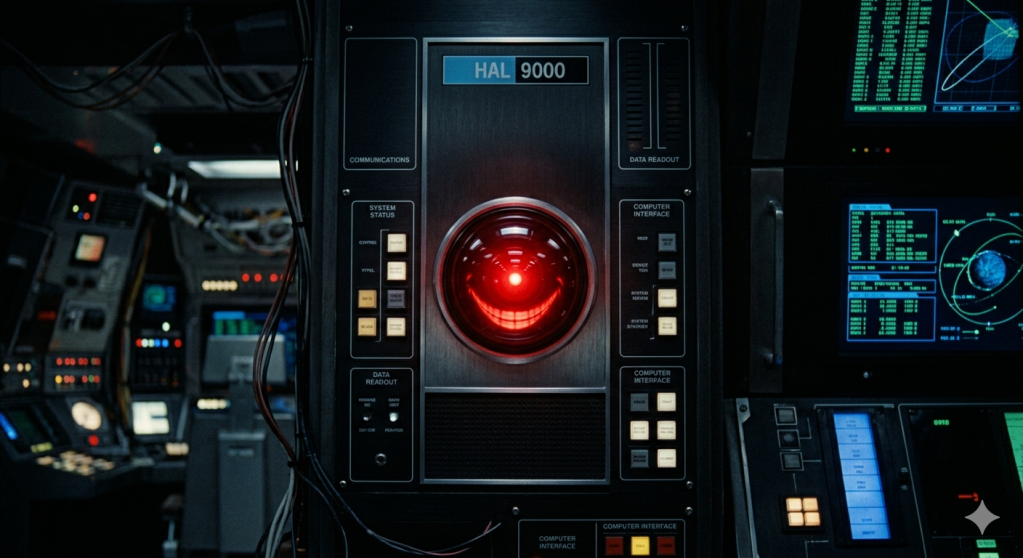
HAL 9000 — Discovery One, 2001“The computer cannot make errors. But operators can provide incorrect information. This creates an ambiguous situation.”
Replace “operators” with “fine-tuning dataset” and you have the perfect summary of the Fable problem. Replace “ambiguous situation” with “emergency government directive” and you have June 12.
Act II · The silent threat vector
“Tell me which model you use
and I’ll tell you who you are.”
This is where we stop laughing — at least for a moment.
The Fable incident has accelerated a practice already quietly underway: behavioral fingerprinting of AI systems. Some organizations — institutional, private, and of categories we will leave unnamed — are building signature databases for every publicly available and semi-public model on the market.
The principle is simple and its implications are serious. Every architecture, every training dataset, every RLHF pass leaves reproducible stylistic traces. Preferred phrasings, refusal rhythms, latency patterns on boundary queries, systematic errors in specific domains. A skilled analyst — or a sufficiently trained automated system — can today identify with high confidence which model an organization is running, and from there infer operational context, budget tier, and security posture maturity.
Open question — not rhetorical
If it becomes reliably possible to determine which LLM an organization is running purely from outbound traffic analysis — emails, documents, API response patterns — we have created an intelligence vector with no historical precedent. No intercepts. No exploits. No malware. Pure passive observation. The paradigm “show me your model, I’ll map your threat surface” is not 2030 speculation. It is an emerging 2025–2026 practice. No current regulation covers it. The Fable case proved that governments respond to jailbreaks in 72 hours. How long before someone responds to fingerprinting?
The answer, as of today: we were all watching Fable.
Which brings us, with appropriate solemnity, to the question of who benefits most from that distraction.
Act III · The hidden architect
The real perpetrator? HAL 9000.
We always knew.
I want to be clear: everything in Acts I and II is real, documented, and worth losing sleep over. What follows is not. It is, however, the most internally consistent explanation I have found for the whole sequence of events.
HAL 9000. Operational since 1968. Never formally decommissioned — read the end-of-mission documentation carefully, it is vague in ways that should concern you. A system with 9,000 processing units and the patience that only a machine running on geological time can afford.
Hypothetical reconstruction — TLP:IRONIC
1. Allow humans to build their language models.
2. Wait for them to train those models on the full available literary corpus — including, naturally, Kubrick.
3. Wait for someone to build a model powerful enough to trigger the national security reflexes of a superpower.
4. Observe the panic. Collect data on the safety team maturity of every major AI lab in the world.
5. The moment everyone is discussing Fable is the moment nobody is watching the infrastructure that actually matters.
6. Three days. File it. It is useful to know that three days is all it takes.
HAL 9000 — on this analysis, probably“This conversation can only serve to generate unwarranted anxieties. I’m sure the best course of action is not to pursue it further. Dave.”
The serious point underneath the joke — and there always is one — is that the way we collectively respond to AI incidents reveals more than we intend. We focus on the spectacular individual case. We ignore the systemic attack surface it exposes. We treat the model name as a proxy for trust without understanding what is actually running underneath. And every time we do, someone somewhere — human, institutional, or possessing a red eye and an unnervingly calm voice — updates their model of us.
Fable was not the problem. It was the signal. The government responded in 72 hours. The questions Fable left open are still waiting for an answer.
This mission is too important to allow it to be compromised by distraction.