
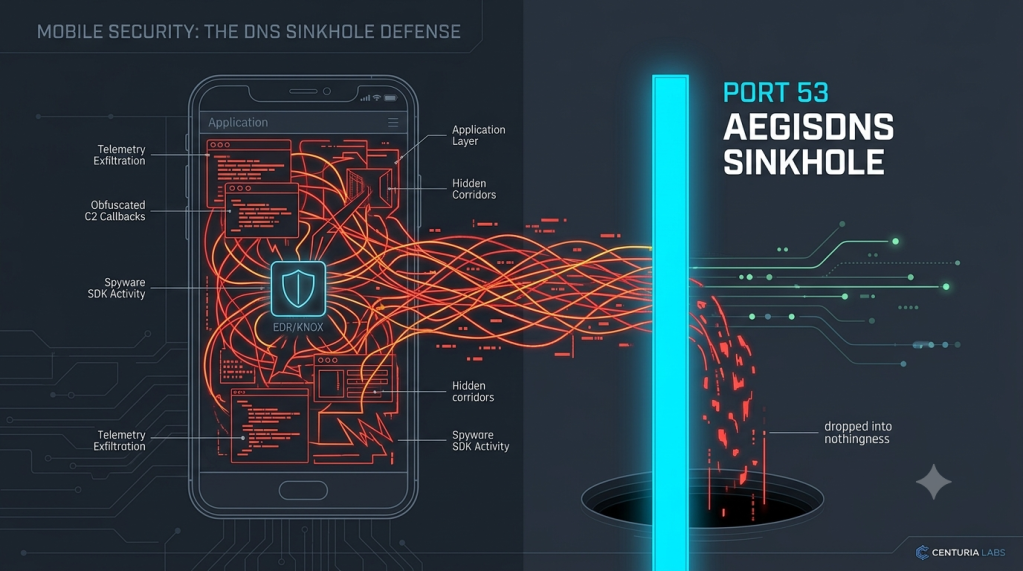
There are currently more active mobile devices on Earth than there are people. Every one of them is a network endpoint. Every one of them resolves DNS. And virtually none of them are protected at the DNS layer in any meaningful way.
The security industry has spent the last decade obsessing over endpoint detection — behavioral agents, kernel-level hooks, ML classifiers running on device. CrowdStrike, SentinelOne, Microsoft Defender, Samsung Knox, Google Play Protect. The investment is real, the technology is serious, and the results are measurable.
And yet.
I have personally tested all of the above against a controlled network monitored by AegisDNS, a Rust-based DNS security engine I built. The result was unambiguous: telemetry exfiltration domains, spyware SDK callbacks, and C2 infrastructure passed through every single one of those endpoint agents without triggering a single alert. AegisDNS blocked them all.
This is not a failure of those products. It is a structural limitation of where they operate — and understanding that distinction is the entire point of this article.
What DNS Sinkholes Do — and What They Don’t
A DNS sinkhole intercepts domain name resolution requests and returns a controlled response — typically a null route or a local IP — instead of the legitimate address. Any client that queries for malware-c2.ru gets back 0.0.0.0. The connection never happens. The packet never exists.
This is architecturally elegant. It operates below the application layer. It doesn’t need to understand what the application is doing — it only needs to see the query. SSL, certificate pinning, obfuscated payloads — none of it matters if the domain never resolves.
What DNS sinkholes do well:
- Block known malicious domains from curated threat feeds — malware, phishing, botnets, telemetry
- Provide network-wide coverage regardless of device type, OS, or application
- Generate per-query logs for forensic analysis and behavioral correlation
- Operate passively without touching device state or consuming endpoint resources
What feed-based DNS sinkholes don’t do:
- Detect domains generated algorithmically (DGA) that aren’t yet in any feed
- Identify behavioral patterns across query sequences
- Block telemetry and spyware SDKs embedded in legitimate, signed applications — unless those specific domains are known
- Distinguish between a legitimate API call and a data exfiltration payload riding the same infrastructure
That last limitation is where the mobile threat landscape gets genuinely interesting, and where proactive structural detection — not just feed matching — becomes essential.
Mobile: The Largest Attack Surface, the Least Defended
Consider the geometry of a modern enterprise attack surface:
- Servers: hardened, patched, monitored, often network-segregated
- Workstations: EDR agents, centralized policy, SOC visibility, DNS logging
- Mobile devices: MDM with varying enforcement, OS sandboxing, and — in the vast majority of deployments — no DNS-layer visibility whatsoever
Mobile devices make DNS queries constantly. Every app, every SDK, every background service. A typical Android device with a standard app portfolio generates thousands of DNS queries per day. The overwhelming majority are legitimate. But embedded within that traffic are queries you almost certainly don’t want resolving.
The mobile threat model has a specific characteristic that makes it uniquely dangerous: the most effective attack vectors are not malware. They are legitimate, signed SDKs doing exactly what they were designed to do.
Advertising SDKs that exfiltrate device identifiers, location data, and behavioral profiles. Analytics libraries that beacon home every user interaction. Telemetry frameworks embedded three levels deep in a dependency tree that the app developer never audited. All signed. All passing integrity checks. All invisible to endpoint agents — not because those agents are poorly engineered, but because of where in the stack the behavior is hidden.
Why Automated Analysis Fails Here: The IPC Bypass
To understand why Knox, Play Protect, MobSF, and MTD agents miss this class of threat, you need to understand the mechanism these SDKs use to hide their behavior from static and dynamic analysis. It operates on three layers simultaneously.
Layer 1 — Lazy heuristic categorization. MobSF and most MTD classification engines analyze the APK, extract strings, and map class hierarchies. When they detect a known advertising SDK package — say, com.mintegral.msdk — they apply a rigid heuristic rule: known ad network package = Advertisement / Riskware (low risk). Analysis stops there. The code is structurally designed to display banners, so any network traffic it generates is presumed to be “loading advertising assets.” The engine moves on. The deeper behavior is never reached.
Layer 2 — Runtime URI construction via IPC obfuscation. Aggressive SDKs do not make direct, visible HTTP calls that static analysis can trace. Instead, they construct the target URI dynamically at runtime — decrypting AES or XOR-encoded strings stored in asset files, or assembling them via reflection and method swizzling. The assembled URI is then passed through an Android Intent or a custom URI scheme (customscheme://) that travels through the OS’s IPC space. No hard-coded domain string exists in the binary. No static scanner sees the destination. MobSF finds what looks like standard inter-component communication — because structurally, it is.
Layer 3 — Signature bypass via legitimate process context. The entire sequence occurs within a legitimately signed APK. The developer imported the SDK dependency without auditing it — this is the norm, not the exception. Knox and Play Protect see authorized components communicating through standard Android constructs. There is no memory exploit, no privilege escalation, no anomalous system call. There is only a legitimate feature of the Android architecture being used for a purpose its documentation does not advertise.
The logical conclusion is precise: an attacker can hide the code, encrypt the strings, abuse Android’s Intent system to deceive MobSF and Knox at every layer of on-device analysis. But at the end of the computational stack, to exfiltrate that packet off the device, the OS must resolve a domain name. The obfuscation stops at UDP/TCP port 53.
No Intent, no reflection, no AES layer obscures a DNS query. It is the one operation that cannot be faked within the device boundary. This is why the network perimeter DNS layer is not an additional defense — it is the last defense that the obfuscation chain cannot bypass.
The Mintegral Case: SIGINT from Reverse Engineering
During research conducted through the GAMA (Greyware Analysis and Mitigation Approach) methodology, I reverse engineered the Mintegral MBridge SDK — an advertising framework embedded in thousands of applications, including titles distributed through official stores.
The SDK implements exactly the IPC obfuscation pattern described above. Network destinations are assembled at runtime. URI schemes route through IPC channels invisible to proxy-based traffic capture. MobSF classifies the package as Advertisement. Knox sees legitimate inter-process communication. Play Protect finds a signed APK with no integrity violations.
I extracted 6 specific domains used by Mintegral for data collection and callback communication. These domains are now part of AegisDNS’s SIGINT intelligence layer — always blocked, zero exceptions, categorized as Spyware.
This is what happened when I tested across enterprise endpoint security products:
| Product | Mintegral domains blocked? | Alert generated? |
|---|---|---|
| Samsung Knox | No | No |
| Google Play Protect | No | No |
| SentinelOne | No | No |
| CrowdStrike Falcon | No | No |
| MobSF (static analysis) | No — classified as Advertisement | No |
| AegisDNS | Yes — all 6 | Yes — SIGINT category |
The reason is not that these products are inferior. Knox is a serious security framework. CrowdStrike’s sensor engineering is genuinely impressive. The reason is architectural: they operate inside the device, where the obfuscation is designed to be invisible. AegisDNS operates at the network perimeter, where the obfuscation is irrelevant.
Why EDR and MTD Cannot Fully Close This Gap
Modern Mobile Threat Defense solutions — including the mobile modules of vendors like CrowdStrike and SentinelOne — are aware of the sandboxing limitation. Their typical mitigation is a local VPN tunnel (NEPacketTunnelProvider on iOS, VpnService on Android) that routes all traffic through a local loopback before it reaches the network interface. In theory, this allows on-device DNS inspection regardless of which app generated the query.
This is a real capability and it should be acknowledged. However, it introduces a different set of constraints that limit its effectiveness in practice:
- Resource consumption: Running a continuous local VPN tunnel with DNS inspection on a mobile device has measurable battery and CPU impact. Users disable it. MDM policies are inconsistently enforced. The agent is not always running.
- DoH and custom APN bypass: An application or an embedded SDK that integrates a native DoH client — issuing HTTPS requests directly to a public resolver on port 443 — bypasses local VPN DNS inspection entirely. The query never reaches the loopback tunnel, and it does not reach a standard port-53 perimeter sinkhole either, appearing instead as ordinary encrypted web traffic to a legitimate IP. A comprehensive network architecture mitigates this by blocking outbound port 443 traffic to known public DoH endpoints at the packet filter level — forcing the OS to fall back to the corporate DNS infrastructure. In AegisDNS deployments, this is enforced via the same iptables layer that already rejects external port-53 queries: no DNS resolution, encrypted or otherwise, exits the network perimeter without passing through the sinkhole.
- No perimeter intelligence context: An on-device agent making a block decision has access only to what it can observe locally. A perimeter DNS engine operating across an entire network segment can correlate query patterns across devices, identify distributed exfiltration campaigns, and apply intelligence feeds of a scale that is simply not deployable on endpoint storage — 651,171 domains in AegisDNS’s current feed set would be operationally impossible to maintain on mobile endpoint memory.
- Scale of intelligence: Maintaining a feed of 650k+ domains on a mobile endpoint is not realistic from a storage, update, and performance perspective. A perimeter sinkhole absorbs that complexity without touching the endpoint at all.
The conclusion is not that MTD is useless — it provides genuine value at the process and behavioral layer. The conclusion is that perimeter DNS security and endpoint security address structurally different parts of the problem. Deploying one does not substitute the other.
What a DNS Engine Needs to Do This at Enterprise Scale
A feed-based DNS sinkhole is necessary but not sufficient. Feeds are reactive — a domain must be known bad before it appears in any list. DGA malware generates thousands of new domains per day specifically to stay ahead of feed updates. DNS tunneling uses structurally valid domains that will never appear in any feed. Typosquatting campaigns register domains hours before launching.
An enterprise-grade DNS security engine requires three capabilities beyond feed matching:
1. Proactive structural detection. The ability to match against the shape of a domain — not its identity. A 47-character random-looking label is not in any feed. But it matches a DNS tunneling pattern. paypa1-secure-login.com is not in any feed yet. But it matches a typosquatting pattern with homoglyph substitution (1 replacing l). This requires a compiled pattern engine — specifically PCRE2, chosen for its support for lookaround assertions and advanced feature set not available in simpler regex engines — applied at query resolution speed.
2. Zero-downtime pattern updates. Emerging campaigns require immediate response. Restarting a DNS service to update detection rules introduces a window of exposure. A hot-reload mechanism — where pattern files are watched and recompiled atomically without dropping queries in flight — is an operational requirement, not a nice-to-have.
3. Real-time telemetry for SOC correlation. A DNS block in isolation is a data point. A DNS block correlated with a simultaneous IDS alert, an anomalous packet volume, and an exfiltration monitor hit is an incident. The DNS engine must expose a structured, real-time event feed that a SOC can consume and correlate — not just a log file.
Building these capabilities on a memory-safe foundation matters beyond ideology. The C codebase underlying most traditional DNS resolvers — including dnsmasq, which powers Pi-hole’s FTL engine — carries the structural risk of buffer overflows and memory corruption vulnerabilities that are impossible in Rust at the language level. For a component that handles every DNS query on a network, that is not a theoretical concern.
On the Block Rate: Understanding the Operational Trade-off
The 15.8% block rate observed across a monitored network segment deserves context, because raw block rate numbers without context alarm administrators rightly.
Amplitude and Firebase are legitimate analytics platforms used by thousands of applications for crash reporting, session state synchronization, and performance metrics. Blocking api2.amplitude.com at the DNS layer will break functionality in applications that depend on it for more than behavioral tracking.
This is a real operational trade-off, and pretending otherwise serves nobody. The value of a DNS security engine is not the block rate — it is the control. AegisDNS allows selective blocking by source IP, time window, and category, passive logging without drop for domains where the risk-to-breakage ratio is ambiguous, and per-domain whitelist overrides that survive feed updates. The 15.8% figure represents a deployment configured for a research context with aggressive telemetry blocking. An enterprise deployment would be tuned differently — likely logging Amplitude traffic without dropping it, while maintaining hard blocks on the Mintegral SIGINT domains and known malware C2.
The point is not to block everything. The point is to see everything, make informed decisions, and enforce those decisions at a layer where enforcement is structurally guaranteed.
Real Numbers from a Live Deployment
From the AegisDNS deployment monitored during this research period:
- 651,171 malicious domains loaded across 11 threat intelligence feeds
- 28,000+ DNS queries processed in a 24-hour monitoring window
- 4,400 queries blocked — 15.8% block rate in research configuration
- 27ms average upstream latency (resolver internal latency significantly lower)
- Top blocked category: Telemetry —
api2.amplitude.comat 728 hits,region1.app-measurement.comat 428 hits - SIGINT layer: 6 Mintegral domains — always blocked, zero exceptions
- Firebase logging: blocked and logged in live query feed
The telemetry category warrants attention. On a corporate device with access to sensitive systems, every event Amplitude or Firebase receives is behavioral intelligence leaving the network perimeter. In regulated industries, that is a compliance exposure. In environments handling sensitive data, it is a threat surface that no endpoint agent currently monitors.
The Architecture: Why Rust and Why It Matters
The performance advantage of a Rust-based DNS engine over Pi-hole’s pihole-FTL — which is a native C binary integrating dnsmasq at source level, not a Python wrapper as is sometimes claimed — is not primarily about speed. On modern hardware, both resolve queries fast enough that raw throughput is rarely the bottleneck.
The meaningful architectural differences are:
Memory safety by construction. Rust’s ownership model eliminates at the language level the class of vulnerabilities — buffer overflows, use-after-free, race conditions — that remain structurally possible in C regardless of developer skill. For a component that parses untrusted network input on every query, this is not a theoretical concern. DNS parsers have a history of memory corruption vulnerabilities. Rust makes that class of bug impossible to compile.
Native async architecture. AegisDNS is built on Tokio’s async runtime, which means concurrent query handling with no thread-per-connection overhead. The PCRE2 pattern engine runs within the same async context, with compiled patterns applied at query time and no global lock required for hot-reload updates — the pattern set is swapped atomically.
PCRE2 for detection, not performance. The choice of PCRE2 over Rust’s native regex crate is deliberate: PCRE2 supports lookaround assertions, atomic groups, and possessive quantifiers that are essential for writing precise DGA and tunneling detection patterns without catastrophic backtracking — features the native crate intentionally omits in favor of guaranteed linear-time execution. The trade-off is acknowledged: PCRE2 is a C library, and its Rust bindings cross an FFI boundary that technically introduces unsafe code outside Rust’s memory safety guarantees. This is mitigated by strict pattern governance — every structural rule in the library is reviewed and regression-tested before deployment, specifically to eliminate patterns susceptible to backtracking amplification or edge-case memory pressure in the underlying C engine. For multi-pattern matching at scale, an Aho-Corasick layer handles the feed domains in O(n) against query length regardless of feed size, while PCRE2 handles the structural pattern library where expressiveness is required.
Implications
The picture that emerges from this research is structural, not vendor-specific.
Most enterprise mobile security postures have a DNS-shaped gap in them. Devices are managed, applications are vetted, endpoint agents are deployed — but the DNS layer, where the most pervasive and least detectable exfiltration happens, is either unmonitored or monitored with tools that cannot match the operational requirements of a live threat environment.
The mobile attack surface is the largest, the fastest-growing, and currently the least defended at the DNS layer. The obfuscation techniques used by aggressive SDK ecosystems are specifically engineered to be invisible to every on-device analysis tool — and they succeed, consistently, against tools from the most well-resourced security vendors in the industry.
The obfuscation stops at port 53. That is where the defense has to be.