
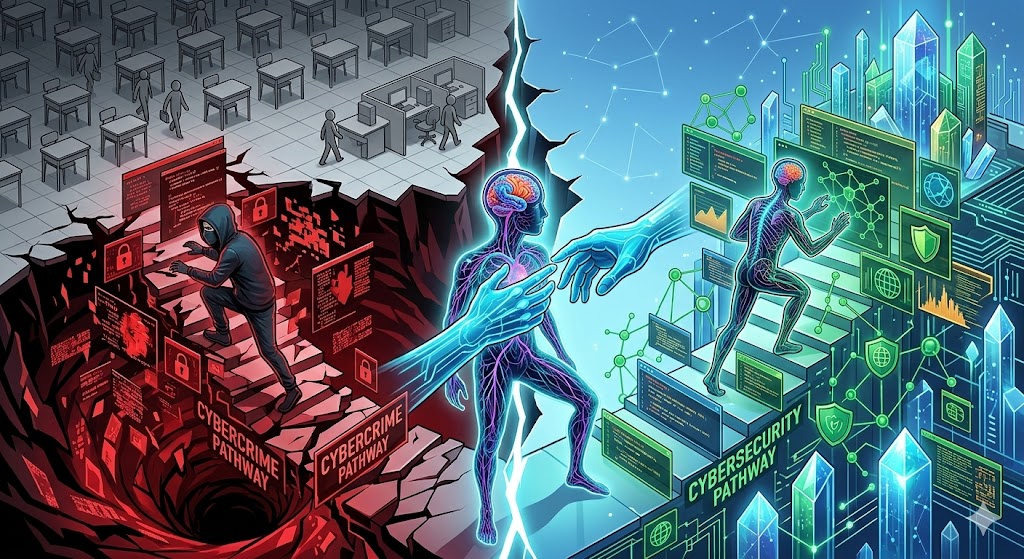
There is a paradox at the heart of the global cybersecurity crisis that is rarely named with the clarity it deserves.
On one side, the sector faces a structural shortage of qualified professionals estimated at 3.5 million unfilled positions worldwide — a figure that grows every year despite investments in training. On the other, a significant percentage of the world’s population naturally possesses the cognitive characteristics most sought after in that sector: complex pattern recognition, hyperfocus on technical problems, non-linear thinking, tolerance for uncertainty, and exceptional attention to detail. This population is the neurodivergent one.
The paradox does not end there. The very people who could fill that shortage are overrepresented in criminal statistics — including those related to cybercrime. Not because neurodivergence produces a propensity for crime. But because the system that should have included them has systematically excluded them, and exclusion has consequences that data document with increasing precision.
This article does not set out to describe a phenomenon — it sets out to analyse its causal mechanism and evaluate whether a tool exists capable of interrupting it before it produces its most costly effects, for the individual and for society.
The research question is precise: is the systemic exclusion of neurodivergent people from legitimate educational and employment pathways a measurable causal factor in the pathway that leads some of them toward cybercrime? And if so, can the availability of accessible cognitive mediation tools — particularly generative artificial intelligence — interrupt that pathway before the critical bifurcation point?
Existing data do not yet allow a definitive answer. They do, however, allow the formulation of a coherent hypothesis, grounded in empirically convergent evidence from different domains, that merits systematic investigation.
THE NEURODIVERGENT COGNITIVE PROFILE IN DIGITAL CONTEXTS
Before analysing the problem, it is necessary to define precisely what we are talking about — because the term “neurodivergence” is used in public debate in an often imprecise way, alternating between pathologisation and romanticisation, both equally misleading.
Neurodivergence describes cognitive architectures that diverge from the statistical norm in terms of neurological functioning — not in terms of capability or value. The principal manifestations relevant to this article are three: Attention Deficit Hyperactivity Disorder (ADHD), Autism Spectrum Disorder (ASD), and 2exceptional profiles, in which cognitive capabilities above average coexist with specific difficulties in executive functioning or social adaptation.
The ADHD brain does not have an attention deficit — it has an attention regulation system that responds to interest, novelty, and challenge rather than bureaucratic deadlines and repetitive tasks. When interest is present, it produces states of hyperfocus — prolonged and deep concentration on a technical problem — which researchers describe as functionally equivalent to the “flow” state documented by Csikszentmihalyi. In high-variability environments such as threat intelligence or penetration testing, this characteristic becomes a documented competitive advantage.
The autistic brain produces, in many cases, pattern recognition capabilities in complex, high-noise environments that significantly exceed the norm. This characteristic has been institutionalised — not for social inclusion, but for operational advantage — by some of the world’s most sophisticated intelligence organisations. Israel Defence Forces Unit 9900 integrates autistic soldiers in visual intelligence analysis roles from satellite imagery because their ability to detect anomalies in complex datasets surpasses that of neurotypical analysts. The British GCHQ and equivalent Australian programmes follow the same logic.
In the private sector, JPMorgan Chase data document that neurodivergent teams structured within the Autism at Work programme worked 48% faster and produced output of 92% superior quality compared to neurotypical colleagues on the same tasks. SAP reports a 90% retention rate for professionals hired through its neuro-inclusive programme.
These are not anecdotal data. They are operational metrics from organisations that chose neurodivergent inclusion not for ethical reasons but for performance reasons.
The starting point is therefore this: there exists a population with documented high-value cognitive characteristics in complex digital contexts. That population is systematically excluded from the pathways that would allow them to express those characteristics in a legitimate and productive way.
OVERREPRESENTATION IN THE CRIMINAL JUSTICE SYSTEM
Data on the presence of neurodivergent individuals in the criminal justice system exist, are verifiable, and converge consistently across countries and methodologies. These are not marginal data — they are data that should generate policy and do not.
In the United Kingdom, the Chief Inspector of Prisons report of 2021 estimates that up to 50% of people entering prison present some form of neurodivergent condition with impact on functional capacity. Specific research on the incarcerated population documents that 25% meet the diagnostic criteria for ADHD and 9% for autism — percentages that exceed by three to five times the estimates for the general population. In New Zealand, Lynch (2016) documented that between 60% and 90% of young offenders probably present some form of neuro-disability.
These numbers do not describe a propensity for crime. They describe a systemic failure of identification and support that begins well before any encounter with the criminal justice system — in school, in the family, in the labour market.
The 2022 ScienceDirect research on neurodivergent minors in the English and Welsh criminal justice system is explicit: educational and youth justice systems are “disabling and criminalising” through processes that label, stigmatise, isolate, and harm neurodivergent children — often unintentionally, but systematically. The problem is not the malevolence of the system. It is its design, built assuming a standard cognitive profile that structurally excludes those who diverge from it.
The University of Bath study published in the Journal of Autism and Developmental Disorders empirically documents that an increased risk of committing cyber-dependent crimes is associated with higher autistic-like traits — and that approximately 40% of this association is mediated by advanced digital skills. The causal direction suggested by the data is precise: it is not neurodivergence that produces the propensity for cybercrime, but the advanced digital skills that often accompany neurodivergence, in the absence of legitimate channels through which to express them.
Six international law enforcement agencies — UK, USA, Australia, New Zealand, Germany, Netherlands, Denmark — have convergently reported a significant presence of individuals with autistic characteristics among cybercrime perpetrators. The picture that emerges is not that of a dangerous population. It is that of a gifted, undiagnosed, unsupported population that found in the digital domain the first environment where its cognitive characteristics produced results.
THE CAUSAL MECHANISM: THE EXCLUSION PIPELINE
The data from the preceding sections, taken individually, describe correlations. Placed in sequence, they describe a mechanism interpretable as a causal pipeline — non-deterministic, non-universal, but sufficiently documented to justify both the hypothesis and systematic research.
The pipeline articulates in identifiable phases.
The first is early educational exclusion. The educational system is designed for neurotypical cognitive profiles. Interest-regulated attention rather than deadline-regulated, non-linear thinking, difficulty with standardised assessment formats, the cost of social masking — systematically produce academic results below actual capabilities, classifications of behavioural “difficulty”, and in many cases early dropout.
The second phase is employment exclusion. The unemployment rate for autistic adults in the United States stands between 30% and 40% — approximately eight times the average. For autistic adults with university degrees, that figure reaches 85%. 76% of neurodivergent job candidates believe that traditional recruitment methods place them at a structural disadvantage.
The third phase is social isolation and the digital refuge. Young neurodivergent people find in the computer and online communities the first space where their characteristics are not a problem but often an advantage. It is in this space that digital skills develop — often to advanced levels, often in communities that do not distinguish between legitimate and illicit applications.
The fourth phase is the bifurcation. The individual possesses advanced digital skills, no integration in the legitimate labour market, no experience of formal channels through which those skills would be recognised. Research indicates that the direction taken — toward white hat or black hat — depends significantly on the opportunity available, not on the individual’s character.
Neurodivergent cybercrime is not the product of a moral choice. It is the product of the absence of accessible alternatives.
AI AS A COMPENSATORY FACTOR: EXISTING DATA
Generative artificial intelligence is not a neutral tool. Like every technology, it amplifies what it finds. The relevant question is not whether AI is good or bad, but whether it can function as a specific compensatory factor in the pipeline described.
A systematic analysis of 45 peer-reviewed studies identified four principal mechanisms through which generative AI tools mitigate ADHD-related difficulties: automatic decomposition of complex tasks, cognitive scaffolding, real-time contextual support, and adaptive learning systems. A 2024 study demonstrated that AI chatbot use improved executive functions compared to traditional therapeutic approaches.
For autistic profiles, AI functions as a translator between the way autistic thinking processes and produces information and the format that the professional context expects to receive. A randomised clinical trial published in the Journal of Autism and Developmental Disorders in 2025 demonstrated measurable improvements in the communicative responses of autistic participants.
The 2023 Harvard-MIT-Wharton research on over 700 consultants documented that AI produces the most significant productivity gains — up to 35% — in workers with greater difficulty in executing linear tasks. It does not amplify the best in the conventional sense: it levels upward. For neurodivergent profiles, this mechanism is particularly relevant: the linear execution difficulties that the labour market penalises are exactly those that AI compensates most effectively.
THE COMPENSATORY HYPOTHESIS
The hypothesis is as follows: the availability of accessible cognitive mediation tools — particularly generative artificial intelligence — can interrupt the exclusion pipeline before the critical bifurcation point, lowering the cost of access to legitimate channels to a level compatible with the productive participation of neurodivergent individuals with advanced digital skills.
Three qualifications are necessary.
The first: AI is not the solution. It is a tool that lowers the cost of a solution that remains structurally human. Inclusion still requires organisations willing to receive non-standard profiles, educational systems capable of early identification without stigmatisation, and policies that recognise the systemic cost of exclusion.
The second: the hypothesis is not deterministic. The described pipeline does not produce cybercrime universally. The hypothesis concerns the reduction of probability in the tail of the distribution — that minority for whom the absence of accessible legitimate channels represented the discriminating factor at the bifurcation.
The third: accessibility is a necessary condition. A tool available only to those who already have access to economic resources and quality connectivity does not interrupt the pipeline — it replicates it at a different level.
The hypothesis is verifiable through longitudinal research designs. No such studies yet exist. Their absence is itself a data point.
IMPLICATIONS FOR EDUCATION, ORGANISATIONS, AND POLICY
For educational systems: early identification without stigmatisation is the priority. Neurodivergent diagnosis at school age should not be an act that follows failure — it should precede the design of the educational pathway. South Korea launched in 2025 a national programme of AI-powered digital textbooks with 760 million dollars invested in teacher training. Estonia aims for universal digital fluency by 2030.
For organisations: neuro-diversity washing — the awareness month poster, the annual webinar — is measurable in its inefficacy. In a sector with 3.5 million unfilled positions, systematically excluding the profiles with the cognitive characteristics most suited to filling them is an economically irrational choice. Structured interviews based on social signals do not measure the ability to analyse security vulnerabilities. Timed assessments do not measure the ability to see patterns in complex datasets.
For policy makers: the cost of neurodivergent exclusion is a measurable fiscal cost — criminal justice system, health, unexpressed productive potential, cybersecurity. No state has yet calculated it systematically. Universal access to AI tools as a cognitive right is not welfare. It is systemic efficiency.
Neurodivergent cybercrime is not the product of a moral choice. It is the predictable product of a system that has built systematic cognitive barriers at every access point and then expressed surprise when part of the excluded population found their space in unregulated contexts.
Generative artificial intelligence does not solve this problem. But it lowers the cost of the solution to a level never before reached. A tool that does not ask the individual to simulate being someone they are not — that meets thinking where it is and makes it communicable in the format the world knows how to receive.
The voice of neurodivergent people in technical and scientific fields is systematically underrepresented in the literature about them. This article is a contribution to bridging that distance — from someone who knows that phenomenon from the inside.
The talent was always there. The channel was missing.